
“The Great Rewiring of Childhood, in which the phone-based childhood replaced the play-based childhood, is the major cause of the international epidemic of adolescent mental illness.”
— Jonathan Haidt, The Anxious Generation
When the iPhone was released in 2007, it quietly altered the course of human development. What began as a tool for convenience soon became a constant companion. Today, most people live within arm’s reach of their phones, checking them dozens or even hundreds of times a day. For children and adolescents, this shift has been especially profound. They are the first generation to grow up fully immersed in a smartphone and social media ecosystem, and the psychological cost has been enormous.
Social media platforms promise connection, entertainment, and self-expression. They do deliver those things, to a point. But they also foster addiction, superficiality, comparison, and hostility. Most concerning of all, mounting evidence shows they are deeply damaging to the mental health of young people.
A Sudden and Alarming Shift
Around 2010, something changed. Rates of depression, anxiety, and self-harm among adolescents rose sharply across the Western world. Teen depression increased by roughly 150 percent. Self-harm among young adolescent girls tripled between 2010 and 2020. By 2020, one in four American teen girls had experienced a major depressive episode in the previous year. Among university students, more than a third now report feeling anxious most or all of the time.
This spike has been largely confined to Generation Z. Older generations did not experience anything comparable. The timing is hard to ignore. The early 2010s marked the moment when smartphones and social media became nearly universal among teens.
As Haidt puts it, Gen Z became “the first generation in history to go through puberty with a portal in their pockets,” one that pulled them away from the people around them and into an unstable, addictive virtual world that the adolescent brain was never designed to handle.
From Correlation to Causation
For years, critics argued that the link between social media and mental illness was merely correlational. Perhaps anxious or depressed teens were simply more likely to retreat into their phones. That argument no longer holds.
A growing body of experimental, longitudinal, and cross-cultural research now supports a stronger conclusion: heavy social media use causes increases in depression, anxiety, self-harm, and loneliness in adolescents. The rapid migration of teenage social life from the physical world to digital platforms was not just associated with the mental health crisis. It helped create it.
The Disappearance of the Play-Based Childhood
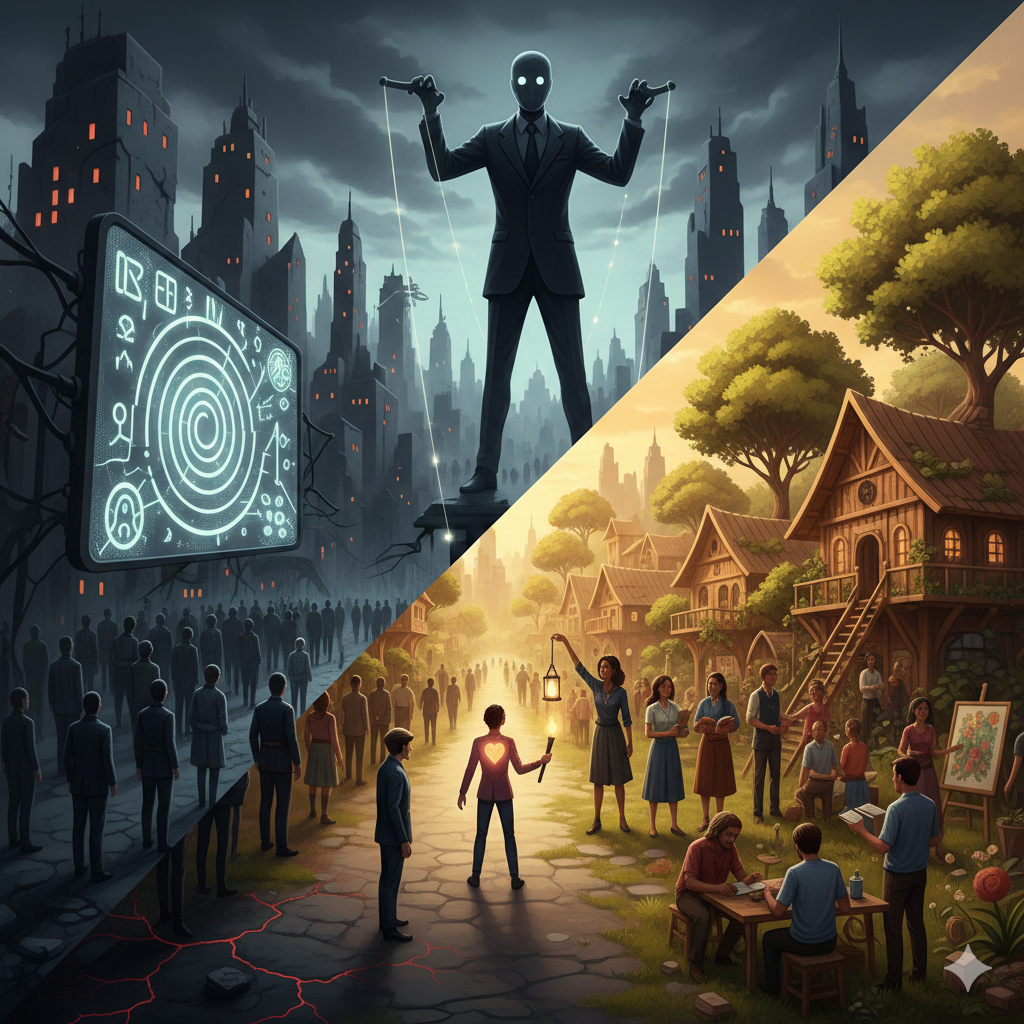
To understand why this shift has been so damaging, we need to look at what children lost when screens took over. For most of human history, childhood revolved around free play. Children spent hours outdoors with peers, inventing games, taking small risks, resolving conflicts, and testing their limits.
This kind of play is not a luxury. It is a biological necessity. Across mammal species, young animals play to develop emotional regulation, social skills, resilience, and confidence. When play is removed, development suffers.
The most beneficial form of play is unsupervised, outdoor play that involves manageable risk. Climbing trees, roughhousing, getting lost and finding one’s way back, dealing with teasing or exclusion. These experiences trigger mild fear and discomfort, but they teach children how to cope. Over time, this repeated exposure reduces anxiety. It works like a psychological vaccine.
When children are deprived of these experiences, their fears do not shrink. They grow.
The Birth of the Phone-Based Childhood
In little more than a decade, free play was displaced by screens. Today, the average teenager spends six to eight hours a day in front of a screen, nearly five of those hours on social media. Many children spend more time interacting with algorithms than with other human beings.
Parents did not cause this shift out of neglect or malice. Smartphones were marketed as harmless, even educational. When every other child had one, refusing felt unrealistic. But what seemed convenient in the short term turned out to be corrosive in the long term.
The phone-based childhood has radically altered attention, relationships, and emotional development.
Addiction by Design
Social media apps are not neutral tools. They are engineered to capture and hold attention for as long as possible. Notifications, infinite scrolling, likes, streaks, and algorithmic rewards are carefully designed to exploit the brain’s reward system.
Children and adolescents are especially vulnerable because the part of the brain responsible for impulse control and long-term planning is not fully developed until early adulthood. Internal documents from social media companies have shown clear awareness of this vulnerability, and a willingness to exploit it.
When children are exposed to these systems during sensitive periods of brain development, habits become deeply ingrained. Physical play and face-to-face interaction are displaced, and neural pathways are reshaped around constant stimulation.
Loneliness in a Connected World
Social media increases the number of connections but reduces their quality. Online interaction strips away body language, tone, timing, and physical presence. Children do not learn how to read faces, manage awkwardness, resolve conflict, or build trust. Emojis replace expressions. Likes replace belonging.
The result is a generation that is more connected than ever and yet profoundly lonely. The more time adolescents spend on social media, the more isolated and depressed they tend to feel. This is one of the great ironies of the digital age.
Humans evolved to connect in person. When that need is not met, mental health deteriorates.
The Collapse of Attention
Constant digital stimulation also fragments attention. Adolescents now receive hundreds of notifications per day. Focus is repeatedly broken before it has a chance to deepen.
Psychologist William James warned that young minds are especially sensitive to immediate stimuli. When attention is constantly hijacked, nothing substantial can be learned or mastered. Skills fail to develop. Progress stalls.
Stagnation, as the writer Colin Wilson observed, is fertile ground for mental illness. When young people reach adulthood without competence, confidence, or direction, anxiety and depression often follow.
Different Harms for Girls and Boys
While both sexes are affected, the damage often takes different forms.
Girls, who use social media more heavily, are especially vulnerable to appearance-based comparison. Platforms overflow with carefully curated and digitally altered images. Constant exposure erodes self-esteem and fuels anxiety, depression, and eating disorders.
Boys, meanwhile, tend to retreat into video games, online forums, and pornography. Many withdraw from real-world challenges altogether. This has contributed to rising numbers of young men who are disengaged from education, work, and relationships, a phenomenon sometimes described as “failure to launch.”
Both patterns reflect the same underlying issue: withdrawal from the physical world during critical developmental years.
A Way Forward
The problem is severe, but the solution is not mysterious. Children need less screen time and more real life. They need independence, responsibility, boredom, risk, and unstructured play. Parents need to set firmer boundaries around technology and resist the urge to use screens as pacifiers.
The phone-based childhood has been, as Haidt describes it, the largest uncontrolled experiment humanity has ever performed on its children. The results are now clear.
If we want mentally healthy adults, we must give children the kind of childhood that human beings evolved to have: one rooted in play, presence, and genuine connection.
— Dr. Vivek G. Vasoya, MD
(Homoeopathic Psychiatrist & Psychotherapist)


















Write a comment ...